On 15 September 2026, we were able to make the following observations, amongst others, at the Oberaar Glacier:
Oberaar Glacier
The Oberaar Glacier on 15 September 2026.
Following the winter of 2025/26, which saw little snow, and the heatwaves of summer 2026, the snow has practically all melted away. We have never seen the Oberaar Glacier like this before.
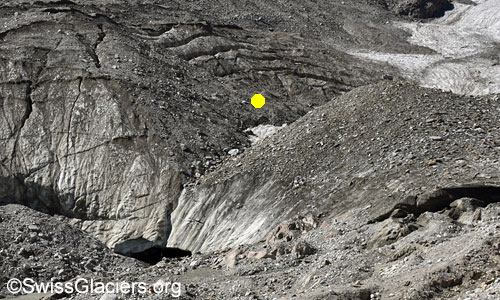
The Oberaar Glacier and the old glacier snout on 15 September 2026.
The old glacier snout was situated on the left, at the foot of the ice face.
Glacier snouts
The old glacier snout of the Oberaar Glacier on 15 September 2026.
Virtually no meltwater flows through the old glacier snout anymore. The ice wall, some 20 metres high, is still very impressive.
The new glacier snout of the Oberaar Glacier on 15 September 2026.
The new glacier snout is situated at the western end of what remains of what was once the central collapse structure.
Oberaar Glacier: New surface outflow of meltwater on 15 September 2026.
Within the space of a year, the two eastern collapse structures have opened up. Furthermore, so much ice has melted that >90 per cent of the meltwater now flows northwards along the glacier towards the former glacier snout. View in the direction of flow.
Legend:
Red dot
A year ago, the eastern collapse structure ended roughly at the red dot. At that time, the area shown in the photograph, which is now flooded with meltwater, was still largely covered by glacial ice.
Yellow dot
This is where the old glacier snout used to be.
Oberaar Glacier: New surface outflow of meltwater on 15 September 2026.
View against the direction of flow.
Legend:
Red dot
The position corresponds roughly to the red dot in the previous photograph.
Yellow dot
This is where the new glacier snout is located.
Dead ice
Permafrost on the southern side of the Oberaar Glacier on 15 September 2026.
On the southern side of the glacier, to the east of the glacier snout at the foot of the slopes, there is still a great deal of dead ice. In some places, this glacial ice is covered with scree and boulders; in others, the dead ice is exposed and directly exposed to the warm air. Green dots: Outline of the dead ice. Yellow dot: Position of the old glacier snout.
A small lake at the foot of the Toteis on the south-facing side of the Oberaar Glacier on 15 September 2026.
The size of the lake has not changed since my last visit, just over a year ago.
Signs of deterioration
Signs of deterioration at the old glacier snout on 15 September 2026.
Two people are shown to give an idea of scale.
Close-up of signs of deterioration at the old glacier snout on 15 September 2026.
Collapse structure
The collapse structures, which are situated approximately 300–350 metres west of the old glacier snout, have changed significantly over the course of just over a year.
Open collapse structures on the Oberaar Glacier, viewed from the east, on 15 September 2026.
The eastern and central collapse structures have opened up completely towards the east.
Legend:
Blue dot
Former eastern collapse structure.
Red dot
Formerly the central collapse structure.
Yellow dot
Western collapse structure.
Western collapse structure in the Oberaar Glacier on 15 September 2026.
The western collapse structure is located at the yellow dot. We assume that the ice in the centre has melted right down to the bottom. A stream of meltwater is likely to be flowing lengthways through the collapse structure at the bottom.
Meltwater
Outflow of meltwater from beneath the glacier on 15 September 2026 at 9.30 am.
Outflow of meltwater from beneath the glacier on 15 September 2026 at 3.40 pm.
For mid-September, the discharge was very high.
Meteo
Temperature: 22° at 2 pm, just above the glacier. Zero-degree limit: 4400m ü.M.,
the previous 7 days at altitudes between 3300 and 4100 metres above sea level, averaging around 3,750 metres above sea level.